
Why I Became a Dog Trainer

The dogs who taught me to listen...

I didn't set out to become a dog trainer.
Honestly, I think the dogs chose me.
I've been fascinated by animals for as long as I can remember, but dogs have always been my number one fascination. I watched them. I noticed their body language. I wondered what they were thinking, what they were trying to communicate, and why they did the things they did.
And then there was Teddy.
My dad wanted a Labrador. He'd grown up with a Lab mix and knew they were good family dogs. He wanted that for us. We got Teddy. He was a Lab mix, technically—but he was also part German Shorthaired Pointer, and he expressed a lot of those GSP tendencies:
High energy. Incredible stamina. Athletic. A little bit of a Velcro dog. A decent prey drive. And an almost comical attachment to his people. If you've ever interacted with a GSP, you know. They're not for the faint of heart.
Teddy was friendly. That was never the problem. He was just... a lot. At one point, my mom even had a backup home lined up for him. A friend's brother with more land had agreed to take him if we decided we simply couldn't manage him.
Thankfully, we figured it out - My dad would take us up to the fields with a tennis ball and let Teddy run, sniff, and retrieve. We learned how much exercise, exploration, and engagement he needed. We adapted our lives around the dog we actually had.
And somehow, that crazy, energetic dog became one of the greatest gifts of my childhood.
Teddy was mischievous in the funniest ways. He stole hot dogs from my younger brother, Tommy, at lake dinners. Teddy knew Tommy was the youngest cousin (at the time), and he would wait for his moment. Somehow, he got the hot dog every single time. We eventually tried positioning Tommy between two older cousins to protect his dinner.
Teddy still found a way. We would all erupt in hysterical laughter.
He ate an entire Easter basket filled with chocolate eggs. He ate a chocolate birthday cake, and we came home to discover him standing on all four feet on top of our dining room table. Somehow, he never got sick from his escapades.
He even attempted his own version of Homeward Bound.
While we were away on vacation, my aunt took him to our lake-house. Teddy apparently decided that this arrangement was unacceptable. His family wasn't there, so he left and started walking down the highway toward home. Home was a twenty-five-minute car ride away. My aunt eventually had to drive after him and found him intentionally walking along the side of the highway, apparently determined to find his people.
I still have no doubt he knew exactly where he was going.
And then there was capture the flag.
Teddy didn't just run around with us. He played. If I army-crawled underneath a bush to hide from the other kids, Teddy army-crawled underneath the bush with me. I'd have to hold his tail so our opponents couldn't hear it wagging through the leaves.
If I hopped a fence, Teddy hopped it too.
He even had this bizarre little trick where he'd try to pick up his tennis ball with his paw, pinning it against his other paw and shaking his "hand" against the ball like a human trapped inside a dog's body. He was just the funniest dog.

But Teddy wasn't only funny. He was there through everything. If I cried, he would quietly sit beside me, put his paw on my shoulder or lap, and let me cry into his neck.
He was also incredibly observant. When I was a college student home alone, a man came to our house claiming to be a plumber my dad had called. My dad hadn't called a plumber.
Teddy had never been a dog who was suspicious of guests. He didn't growl at people coming into our house. He was friendly and social with guests. But something about this man was different. Teddy sensed it before I did. He showed his teeth, gave a low growl, and positioned himself between me and the man.
I knew to listen to him.
I told the man I couldn't let him in, that my dog would bite him, and shut the door. I immediately called my dad, who confirmed he hadn't called anyone and told me to call the police. I still don't know exactly what would have happened that day if Teddy hadn't been there.
But I know that I trusted him.
I also learned so much watching Teddy freely interact with other dogs. He had opportunities to explore, play, communicate, and just exist as a dog. He was incredibly clear in his communication, and the neighborhood dogs seemed to understand him.
In fifteen years, he was never in a dog fight. He was the calm, centered, balanced, friendly dog you would want beside you if you were helping another dog learn how to navigate the world.
Looking back, Teddy had something I want for every dog:
a life in which he was allowed to be a dog.
He had freedom to explore. He could smell. He ran. He played. He interacted with other dogs. He came with us to the lake. He slept in my bed and on the furniture. He got Christmas presents from Santa and birthday presents.
He wasn't "just a dog." He was our family member. And he was also allowed to express himself as a dog.
I think that's where one of my earliest lessons came from:
Learn to love the dog you actually have.
Not the dog you imagined.
Not the dog you thought you were getting.
The dog standing in front of you.

Another huge part of my education came from the shelter dogs I volunteered with.
Some dogs would come across as fearful, aggressive, reactive, tense, or completely shut down. From inside the shelter, they could look almost unadoptable. But then you'd take them outside. And sometimes, it was like watching an entirely different dog emerge.
They'd shake off. They'd take a breath. They'd start looking around. Slowly, they became more available to what was happening around them.
Some wanted to play.
Some wanted to sit quietly beside you.
Some were so tightly wound that they needed to walk for thirty minutes before they could really engage with anything else.
Every dog was different. Those dogs taught me something I carry with me into every case today:
Behavior doesn't happen in a vacuum.
Sometimes what looks like aggression is fear.
Sometimes what looks like stubbornness is overwhelm.
Sometimes what looks like a dog who "doesn't listen" is a dog who is simply too stressed to process what we're asking.
And sometimes the best thing you can do is NOT to ask the dog for more.
It's to give them less.
Less pressure. Less stimulation. More space. More time. More opportunity to decompress.
Those dogs taught me to meet dogs where they are rather than where I wish they were. They taught me that a dog isn't a "bad dog" because they're struggling to cope.
Sometimes they're just stressed.

Then there was Cali. My first canine partner in Animal Assisted Intervention. Cali taught me perhaps one of the most important lessons of my career. When she came into my life, I wanted, or expected, her to be like a Labrador, the picture perfect therapy dog we all imagine. I wanted her to be friendly with everyone. Social. Excited to greet people. Easygoing when guests came into the house.
I wanted people to walk through the door and think, What a nice dog.
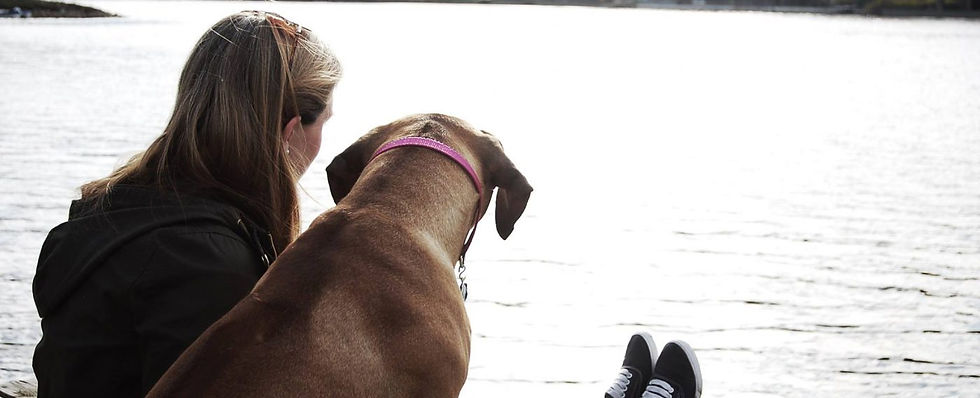
For about five years, I wanted her to be something she simply wasn't. Cali was a Rhodesian Ridgeback. She was calm, observant, sensitive, independent, stoic, and selective about who she truly wanted to interact with. She tolerated plenty of interactions but enjoyed a select number.
But in her working environment, she was extraordinary. Other trainers called her "bomb proof." She could walk into an unfamiliar environment, take in what was happening around her, and remain appropriate and unshaken.
She worked alongside children with a wide range of needs and navigated busy, unpredictable school environments with incredible composure.
She assisted me with demonstrations for new and experienced handlers alike. She also assisted dogs who were learning how to navigate the working world themselves. When a newer dog was entering an unfamiliar setting or working through a new training scenario, Cali's calm, neutral presence gave them a steady example to observe. She didn't need to teach them anything. She simply went about her business.
Calm. Confident. Comfortable.
And the other dogs could take in that information while they figured out their own environment.
There was one moment at a working dog conference that still makes me laugh and perfectly captures who Cali was.
We were staying at a hotel we'd never been to before, surrounded by people from all over the world and a room full of working dogs. There was only one dog there that Cali had met before. Everyone else was a stranger. During the presentations, Cali lay quietly beside me underneath the table. Completely relaxed. Completely unphased.
During a break, I got up to go to the ladies' room. Cali got up and walked right alongside me. Into the bathroom. Into the stall.
And that's when I looked down and realized...
Her leash wasn't attached to her collar.
Apparently, at some point during the presentation, it had come detached, and neither of us had noticed. She had been completely loose in a room full of unfamiliar dogs, unfamiliar people, and unfamiliar surroundings—and apparently decided there was absolutely no reason to tell me.
Mom's walking? I'm walking.
Mom's going to the bathroom? Apparently, we're going to the bathroom.
That was Cali. She didn't need to investigate everyone. She didn't need to greet every dog. She didn't need to monitor the room.
It wasn't her territory. It wasn't her problem.
And that's exactly how she was at school. Home, however, was different.
Home was Cali's off switch.
It took me a while to understand—and respect—that she needed that.
Her working days could be incredibly busy. Sometimes they were emotionally heavy. She worked alongside students with significant needs, and there were days when those interactions involved deep trauma, big emotions, and a lot for both of us to process.
Through all of it, Cali remained calm, appropriate, and unshaken.
She was there. She was available. She did her job beautifully.
But when we came home, she needed something different:
She needed to be able to completely relax.
She didn't need to be the calm facility dog.
She didn't need to greet everyone.
She didn't need to accommodate every person who walked through the door.
She needed an off switch.
And I needed to learn that it was okay for her to use it.
If I'm being completely honest, my ego as a dog trainer got in the way.
I was proud of Cali. She was an A+ facility dog. Other handlers trusted her. She was calm, appropriate, and unshaken in environments that could be incredibly unpredictable.
So, when that same dog was different at home, it was hard for me to reconcile the two.
If a friend came over and Cali made it clear she wasn't thrilled about an unfamiliar person entering her space, a little voice in my head would say:
They're going to think I'm nuts.
I'm a dog trainer. What are people going to think about my dog?
Looking back, I realize that was my ego talking. I was more concerned with what her behavior said about me than I was with listening to what she was telling me. My partner was telling me very clearly what she needed. She needed home to be her off switch.
Once I stopped worrying about what other people thought and started respecting what Cali needed, everything became easier. I didn't have a lesser dog because she didn't want strangers coming into her home. I had a dog who had spent years being exceptionally good at her job—and finally needed permission to come home and not have one.
So now, when we have a party or I know the house is going to be chaotic, Cali goes to the "spa."
The spa is my bedroom.
She gets her bed, comfortable blankets, fresh water, a bully stick, sunlight, and white noise.
She gets to relax while the chaos happens downstairs.
And when things settle down, she comes back out.
She's happy.
She's rested.
I'm relaxed.
Everyone gets to enjoy the day.
How could I ask a Rhodesian Ridgeback—a breed developed to be discerning about strangers and protective of its home—to happily accept a house full of unpredictable people?
I can't.
And I shouldn't.
I didn't get the Ridgeback who loves every person who walks through the door.
I got Cali. And once I stopped trying to make her into the dog I thought she should be, something changed. She became more relaxed. I became more relaxed.
And somehow, we understood each other so much better.
I think that's ultimately why I became a dog trainer. Not because I believe I have all the answers. Quite the opposite. My dogs have taught me that the more I learn, the more questions I have. I've changed my mind. I've learned from mentors with very different approaches. I've learned that no two dogs are exactly alike, and that a good trainer needs a full toolbox—not because there is one perfect method, but because there is no one perfect dog (or human, for that matter).
I want dogs to feel safe, understood, and confident.
I want them to trust their families to have their backs.
I want them to have ways to communicate when they're uncomfortable, overwhelmed, scared, or simply don't want something.
And I want humans to learn how to listen.
Because our dogs are communicating with us constantly.
Sometimes we're just not speaking the same language.
One of the things I say to clients over and over is:
"Your dog isn't being bad. They're communicating something you don't understand yet."
That doesn't mean we have to accept every behavior. Dogs need boundaries, structure, and training. They need skills that allow them to live safely and successfully in our human world.
But I believe we have to start by asking why.
What is the dog telling us?
What does the human need?
Where is the disconnect?
What can we change so that both can thrive?
My goal isn't to create the perfectly obedient dog every time. It's to help humans and dogs understand each other well enough to live together in harmony. Because sometimes the dog doesn't need to become the dog you imagined.
Sometimes you just need to learn to love and understand the dog you actually have.
And sometimes, when you do, you discover that the dog you have is so much better than the one you imagined in the first place.


Comments